
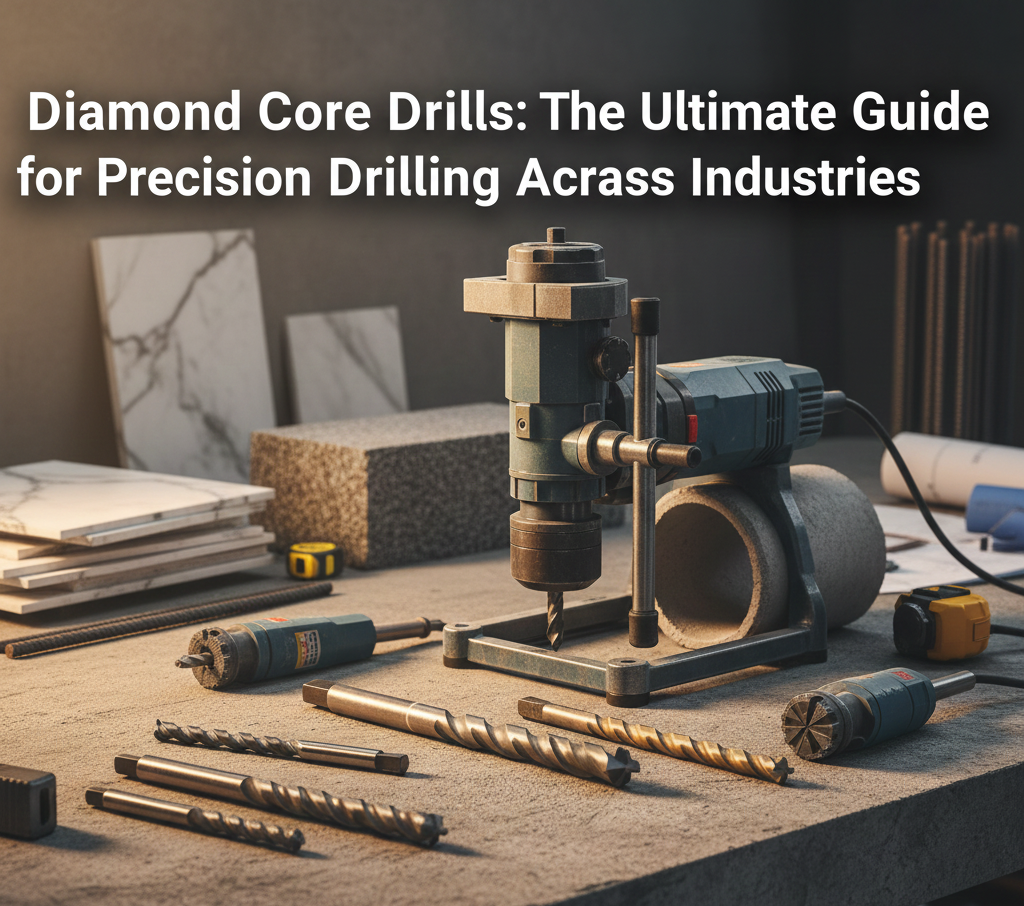
Diamond core drills have become the go-to solution for professionals who demand accuracy, speed, and clean results when working with hard and brittle materials. Whether it’s glass, ceramics, composites, gemstones, or advanced semiconductor substrates, these drills deliver unmatched performance where traditional tooling fails. Their ability to drill precise holes with minimal chipping, faster cutting action, and long tool life makes diamond core drills essential for industries ranging from photonics and aerospace to construction and laboratory research.
In today’s high-precision world, manufacturers, engineers, and fabricators look for tools that can keep up with evolving materials and high-tolerance requirements. Diamond core drills are engineered exactly for that purpose. This blog explores how they work, their different types, the materials they are designed for, and why choosing a trusted brand like UKAM Industrial Superhard Tools ensures better process efficiency and superior results.
What Makes Diamond Core Drills Essential?
The growing use of ultra-hard and brittle materials in modern applications demands tools that can withstand high stress without compromising accuracy. Diamond core drills are manufactured with industrial-grade diamonds bonded to the drill’s cutting edge. When these diamonds interact with hard materials, they grind through the surface instead of tearing or fracturing it, allowing for clean, smooth holes.
Key Advantages Include:
Minimal chipping and cracking, even in brittle materials
Higher precision for clean, round, mirror-smooth holes
Longer tool life compared to carbide or steel drills
Reduced heat generation with proper coolant flow
Versatility for wet and dry drilling applications
These advantages make diamond core drills ideal for industries that cannot afford surface damage, dimensional inaccuracies, or material loss.
How Diamond Core Drills Work
The drilling mechanism is based on a grinding action rather than cutting. Industrial diamonds embedded in the drill’s bond remove material through abrasion, creating a uniform hole while preserving surface integrity.
Important factors influencing performance include:
Bond type (metal bond, resin bond, electroplated)
Diamond grit size
Drilling speed (RPM)
Feed rate and pressure
Coolant or lubrication method
Selecting the right combination ensures faster drilling, reduced wear, and consistent results.
Different Types of Diamond Core Drills
To accommodate a wide range of materials, diamond core drills come in several configurations.
1. Metal Bond Diamond Core Drills
Known for durability and long life, metal bond drills are ideal for high-precision applications and tough materials like quartz, sapphire, ceramic substrates, and composite materials.
2. Electroplated Diamond Core Drills
These drills deliver fast, aggressive drilling and are perfect for softer materials or single-use precision tasks. Their sharp cutting edge ensures minimal heat buildup.
3. Resin Bond Diamond Core Drills
Designed for ultra-fine finishes and delicate materials, resin bond core drills reduce micro-cracking and surface stress.
4. Thin-Wall Diamond Core Drills
Made for small holes, delicate substrates, and high-tolerance applications. Thin walls improve speed and reduce material loss.
Choosing the correct type ensures better cutting efficiency, smoother hole quality, and improved tool longevity.
Applications Across Multiple Industries
Diamond core drills are used in a wide range of sectors where accuracy and surface quality are critical.
Electronics & Semiconductor Manufacturing
For drilling silicon wafers, sapphire wafers, fused silica, and other advanced substrates used in advanced electronics and photonic devices.
Photonics and Optics
Ideal for optical glass, laser components, lenses, filters, and precision photonics materials. Clean edges and crack-free holes are essential in these high-performance applications.
Aerospace & Automotive
Used for composite panels, ceramics, carbon fiber, and hybrid materials utilized in aircraft components, thermal barriers, and high-performance automotive parts.
Construction & Core Sampling
Large-diameter diamond core drills are used for drilling concrete, stone, granite, and structural materials for plumbing, HVAC, and testing applications.
Jewelry & Gemstone Processing
Perfect for drilling gemstones, beads, and delicate crystals without fracture.
Laboratories & Research Facilities
Used for specimen preparation, micro-drilling, and high-accuracy sample extraction.
How to Choose the Right Diamond Core Drill
When selecting a drill for your material and application, focus on the following:
Material Type
Hard materials may require metal-bond drills, while softer materials may benefit from electroplated or resin-bond drills.
Hole Diameter & Tolerance
Thin-wall designs are ideal for micro-drilling and precision hole requirements.
Drilling Method
Wet drilling improves tool life and reduces heat. Dry drilling may be used for convenience but requires careful control.
Machine Compatibility
High-speed spindles, CNC systems, handheld tools, and specialty drilling setups may require different shank types or custom designs.
Desired Surface Finish
Finer diamond grit produces smoother surfaces; coarser grit drills faster but leaves a rougher finish.
Working with a trusted manufacturer like UKAM Industrial Superhard Tools ensures you get the right drill customized to your application needs.
Tips for Maximizing Tool Life and Performance
Use adequate coolant to reduce heat and enhance finish quality
Maintain the right RPM and feed pressure
Avoid forcing the drill—let the diamonds perform the cutting
Use a drill guide or jig for small holes
Dress the drill periodically to expose fresh diamonds
Proper technique dramatically increases cutting efficiency and reduces tool wear.
Why Industries Prefer Diamond Core Drills Over Standard Tools
Traditional drills cannot handle the hardness or brittleness of modern engineering materials. They often generate excessive heat, cracking, and micro-fractures.
Diamond core drills, on the other hand:
Deliver unmatched precision
Improve material integrity
Reduce material waste
Lower overall production costs
Allow consistent results in high-volume production
Their reliability and versatility make them indispensable across high-tech industries.
Frequently Asked Questions
1. What materials can diamond core drills cut?
They are suitable for glass, ceramics, quartz, sapphire, silicon, composites, gemstones, porcelain, stone, and many other hard or brittle materials.
2. Can diamond core drills be used dry?
Yes, but wet drilling is recommended for longer tool life, better cooling, and smoother hole quality.
3. How long does a diamond core drill last?
Longevity depends on material hardness, drilling speed, coolant usage, and tool type. Metal bond drills typically last the longest.
4. How do I prevent chipping when drilling glass or ceramics?
Use low pressure, proper lubrication, and start drilling at a slight angle to create a guide before straightening the tool.
5. Are diamond core drills suitable for CNC machines?
Absolutely. Many industries use them on CNC systems for automated, high-precision drilling.
Conclusion
Diamond core drills have transformed the way professionals work with hard, brittle, and precision-sensitive materials. Their ability to deliver clean holes, reduced chipping, longer tool life, and consistent accuracy makes them essential across industries such as semiconductor manufacturing, photonics, aerospace, construction, jewelry, and research laboratories.
By selecting the right drill type, using proper drilling techniques, and maintaining optimal coolant flow, users can significantly enhance drilling performance and extend tool life. Partnering with an experienced manufacturer like UKAM Industrial Superhard Tools ensures you receive the most advanced diamond core drills engineered for your exact application. As materials continue to evolve, choosing the right drilling technology becomes even more crucial—making diamond core drills the most reliable and future-ready solution for precision drilling needs.