
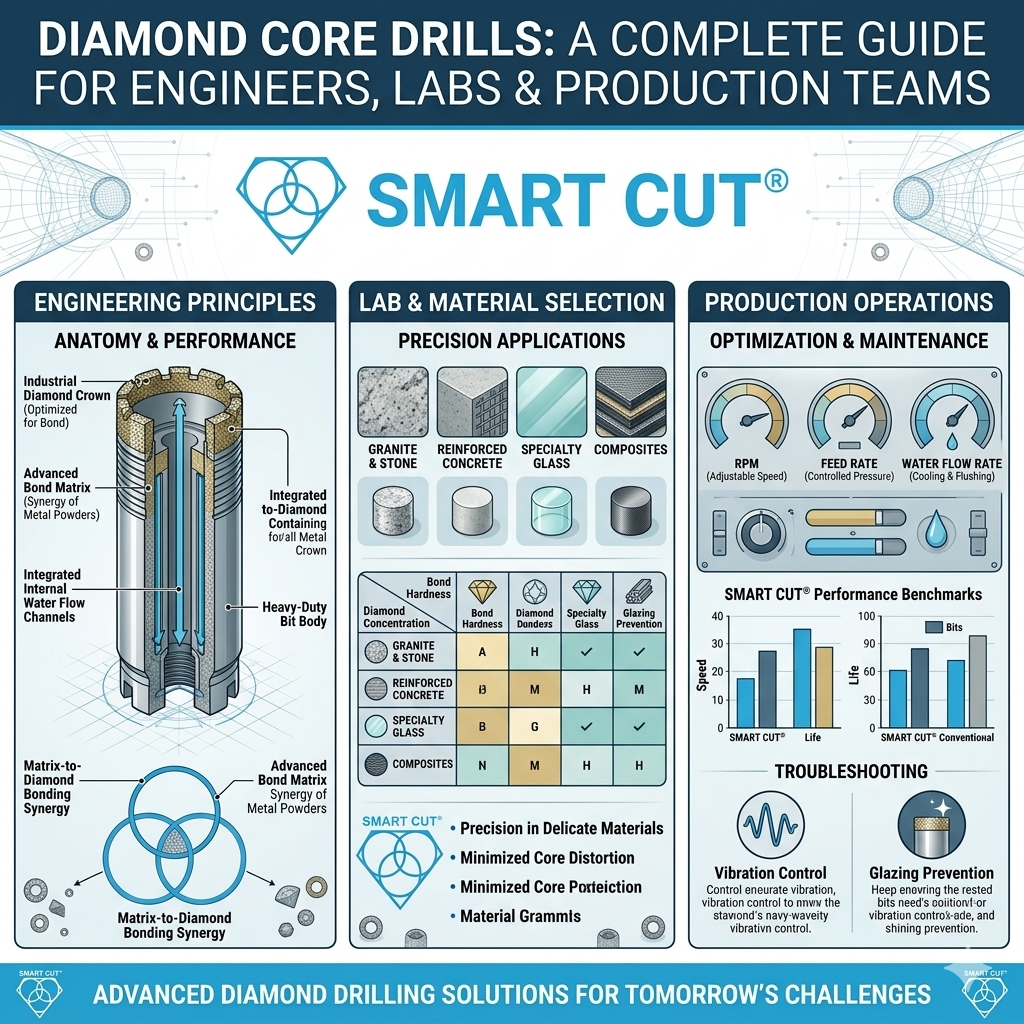
When precision matters at the micron level, the cutting tool you choose is never a generic decision. Whether you're drilling through advanced ceramics, optical glass, sapphire substrates, or silicon carbide composites, the performance of your diamond core drill directly affects hole quality, surface finish, tool life, and ultimately the integrity of your final component. This guide is written specifically for engineers, process technicians, R&D labs, and manufacturing teams who need to make informed, technically grounded decisions — not browse a catalog.
What Is a Diamond Core Drill and How Does It Work?
A diamond core drill is a hollow cylindrical cutting tool with diamond abrasive particles bonded to its working end. Unlike solid drills that remove material as chips, a core drill removes a cylindrical plug of material — called the core — from the workpiece, leaving a clean, precise hole behind. The diamond particles act as the cutting medium, grinding through the substrate as the tool rotates under controlled speed, feed rate, and coolant flow.
The core-removal mechanism makes these tools particularly valuable when hole quality, diameter accuracy, and substrate integrity are non-negotiable. In applications ranging from semiconductor wafer preparation to optics assembly, even a few microns of deviation or surface cracking can render a component unusable.
Diamond core drills are available in a wide range of outside diameters — from 0.5 mm for micro-drilling applications up to 1,219 mm for large-format industrial coring. Wall thickness, diamond grit size, bond type, and concentration all interact to define how a given drill behaves on a given material.
Bond Types: Matching the Tool to the Material
One of the most consequential specification decisions in diamond core drilling is bond type. The bond matrix holds the diamond particles in place and controls how they are released as the tool wears. Selecting the wrong bond for your material is one of the most common causes of premature tool failure, poor hole quality, and excessive heat generation.
Sintered (Metal Bond) is the most widely used bond type across industrial, R&D, and precision manufacturing environments. It offers superior tool life, consistent performance across a wide hardness range, and the ability to drill ultra-hard and brittle materials including advanced ceramics, quartz, alumina, zirconia, and silicon carbide. Metal bond drills are preferred when drilling depth, dimensional repeatability, and hole straightness are critical.
Electroplated (Nickel Bond) drills use a single or multi-layer nickel alloy matrix to expose diamond particles at maximum protrusion. This produces aggressive, fast cutting action with minimal heat generation — making electroplated drills well suited for softer materials such as glass, optical substrates, composites, and natural stone in the Mohs 1–6 range. Multi-layered electroplated drills, such as those using three layers of diamonds rather than the conventional single layer, provide significantly longer drill life and more consistent surface finishes.
Hybrid Bond and Resin Bond options also exist for specific applications where a balance of cut rate, surface finish, and controlled wear is needed — particularly in sample preparation and cross-sectioning workflows.
Grit Size, Concentration, and Tolerance: The Spec Variables That Define Results
Beyond bond type, three other variables significantly impact diamond core drill performance:
Diamond Grit Size controls the trade-off between cut rate and surface finish. Coarser grits (e.g., 40–80 mesh) remove material faster but leave a rougher surface. Finer grits (e.g., 200–400 mesh) produce smoother hole walls and reduced subsurface damage, which is critical when drilling optical glass, sapphire, or single-crystal materials. Selecting the right grit size for your material hardness and required surface finish is essential to optimizing output.
Diamond Concentration determines how many abrasive particles are present per unit volume of bond. Higher concentration extends tool life but can increase cutting resistance. Lower concentration promotes faster, freer cutting action on softer or more abrasive materials. Production environments that run high cycle volumes need this variable dialed in carefully to balance throughput with tool cost.
Tolerances are where precision manufacturing environments separate commodity tools from engineered solutions. Standard tolerance on outside or inside diameter runs at ±0.004" (100 microns). For applications requiring hole geometry control in optics assembly, medical device manufacturing, or semiconductor fixtures, special tolerances down to ±0.0005" (12 microns) are achievable — but require tools manufactured with the precision and process control that only a dedicated industrial manufacturer can deliver.
Materials and Industries Where Diamond Core Drilling Is Critical
Diamond core drills are the tool of choice wherever conventional high-speed steel or carbide drills fail. The combination of extreme hardness, chemical inertness, and thermal stability makes diamond the only viable abrasive for many advanced materials.
In semiconductor and electronics manufacturing, diamond core drills are used for machining monocrystalline silicon, precision fixture fabrication, and creating through-holes in inspection jigs. In optics and photonics, they enable accurate hole placement in lenses, mirrors, and optical assemblies where positional accuracy is measured in microns. In aerospace and medical device production, components made from titanium alloys, alumina, and zirconia demand tight hole tolerances with no subsurface cracking or delamination — conditions that rule out abrasive or impact-based drilling methods entirely.
Additional materials commonly drilled with diamond core tools include: borosilicate and fused silica glass, sapphire, silicon nitride, aluminum oxide, carbon fiber composites, granite and hardstone, and various technical ceramics used in defense and industrial applications.
SMART CUT® Technology: Why Bond Engineering Matters
Not all diamond tools are built the same, and the bond formulation is where most of the performance difference lies. SMART CUT® technology, developed by UKAM Industrial Superhard Tools since 1990, orients diamond particles within the bond matrix so that each crystal is positioned to participate actively in the cutting action. As the outer bond layer wears, a fresh layer of exposed diamonds is activated — maintaining consistent cutting speed, minimizing chipping, and prolonging tool life beyond what conventional bond designs allow.
This approach to bond engineering means less dressing required, more consistent hole quality across a production run, and lower total cost per hole — metrics that matter in any production or R&D environment where tool changes interrupt throughput.
Custom Diamond Core Drills: When Standard Specs Won't Do
Many precision applications don't fit standard catalog dimensions. Custom diamond core drills can be manufactured to your specific drawing or specification — including non-standard outside diameters, wall thicknesses, shank configurations, drilling depths, and bond formulations. Minimum order quantities are not required, and lead times of one week or less are achievable for most custom configurations. This makes custom tooling a practical option even for prototype runs and low-volume R&D programs, not just high-volume production.
Frequently Asked Questions
Q: What is the difference between a diamond core drill and a diamond solid drill? A diamond core drill is hollow and removes a cylindrical plug of material, leaving a clean through-hole. A solid diamond drill removes all material as fine particles and is typically used for smaller-diameter holes where core removal is not practical.
Q: Do diamond core drills require coolant? Yes. Coolant — water, water-soluble fluid, or mineral oil depending on the application — is essential for managing heat, flushing swarf, and extending tool life. Dry drilling is possible with some electroplated tools in limited scenarios, but wet drilling is strongly recommended for sintered bond tools and any precision application.
Q: How do I select the right diamond grit size for my material? Harder, more brittle materials generally benefit from finer grits to minimize subsurface cracking. Softer, more porous materials can tolerate coarser grits for faster material removal. Your tool manufacturer should be able to recommend a starting specification based on material type, drilling depth, and required surface finish.
Q: Can diamond core drills be used in standard CNC machining centers? Yes, provided the spindle speed, feed rate, and coolant delivery are configured appropriately for diamond tooling. Drilling parameters vary significantly from those used with carbide or HSS tools. Incorrect speeds or feeds are one of the primary causes of premature tool failure.
Q: What tolerances are achievable with precision diamond core drills? Standard manufacturing tolerances run at ±0.004" (100 microns). Precision applications in optics, semiconductor, and medical device manufacturing can require tolerances down to ±0.0005" (12 microns), which is achievable with properly engineered sintered bond tools manufactured under rigorous process controls.
Q: Is there a minimum order quantity for custom diamond core drills? At UKAM Industrial Superhard Tools, there is no minimum order quantity on custom diamond core drills. This is specifically designed to support R&D programs, prototype development, and low-volume precision production where standard catalog tools don't meet the application requirement.
UKAM Industrial Superhard Tools has been manufacturing diamond core drills for engineers, laboratories, and production environments since 1990. For technical consultation on drill selection or custom specifications, contact the UKAM applications team directly.